Introducing Club Score
We've been working on a way to rate players for a while. Today it has a name: Club Score.
Club Score is a single number for each player that says roughly how strong they are, and it updates after every game you log. It helps your group set up fairer matches, lets players of every level compete on equal terms, and shows how each person is improving over time.
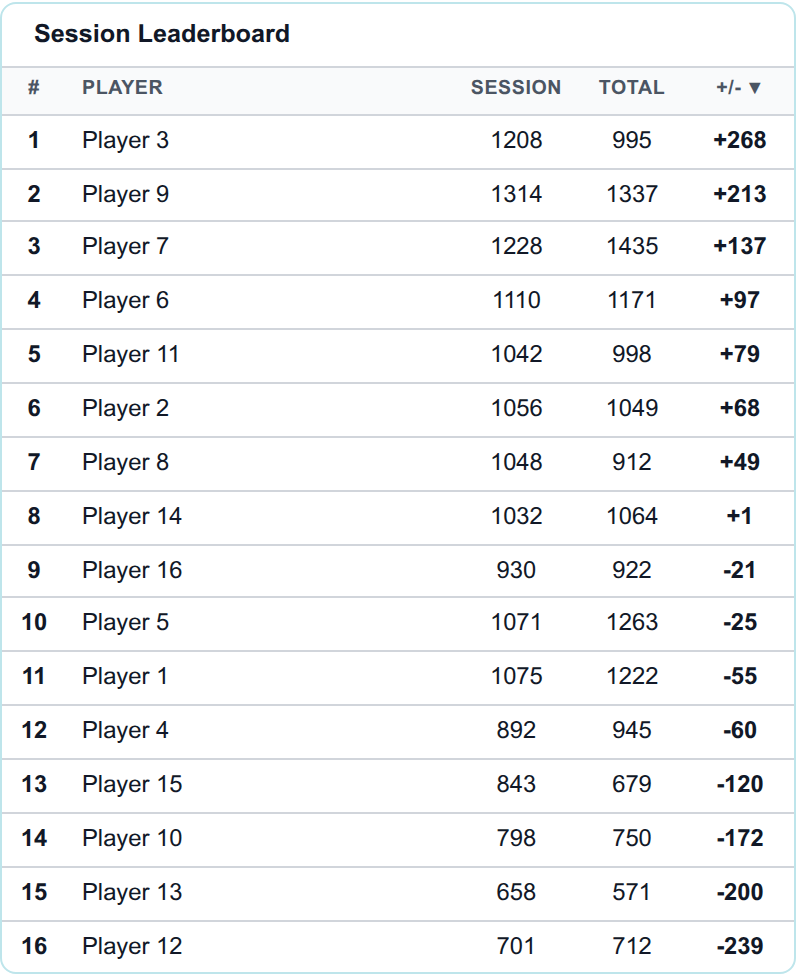
This post explains what Club Score is, how it moves after a game, how it settles for new players, and why we ask you to log results. The screenshots come from a practice session with 16 made-up players, Player 1 to Player 16. The results are simulated, so don't read anything into who ended up on top.
What is Club Score?
To build Club Score we took two well-known ways of rating players and used the best of each.
- OpenSkill is an open-source rating system made for games with several players and teams. It belongs to the same family as Microsoft's TrueSkill, which was built to rate players in team games. That matters here, because doubles gives two people one shared result.
- The Elo rating system is the one most people know. It is widely used in chess and many other competitions, and its numbers are familiar: a bigger number means a stronger player.
Club Score uses OpenSkill in the background, because it handles teams properly, but we shift and scale the result to the familiar Elo pattern. A regular player starts at 1000, and a stronger player has a higher number. You get the maths that suits doubles, in a number that looks like the ones you've seen before.
Where you'll see Club Score
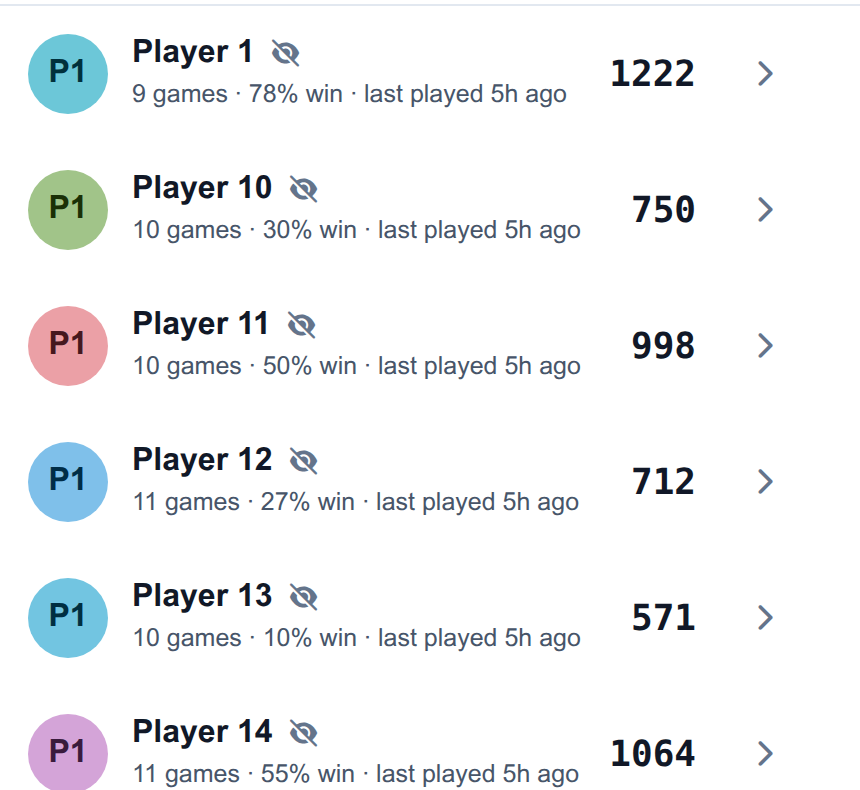
- The Players list. The big number on the right of each player.
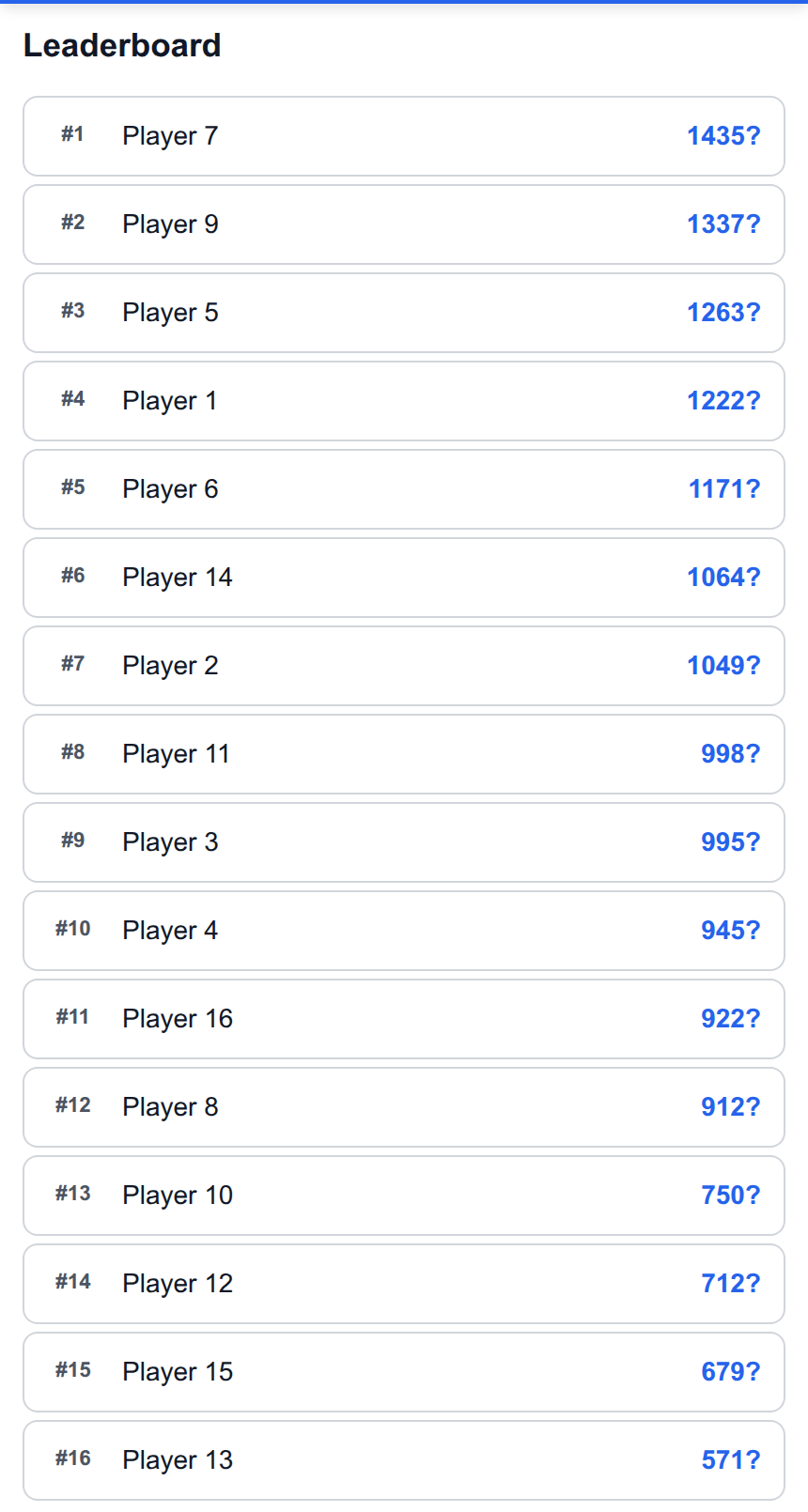
- The all-time Leaderboard. Everyone ranked by Club Score.
- The session leaderboard. Three columns: Session Club Score, Total Club Score and Club Score Change (explained below).
- Player chips. In session setup, choose Club Score to show each player's number on their chip.
How Club Score moves
After every game with a logged result, the app compares the two pairs and adjusts all four players' scores. Five things are worth knowing.
1. Win and you go up. Lose and you go down.
Each player's score moves, not just the pair's. If you and your partner win, you both go up. A draw counts as a tie, so the stronger side gives up a little and the weaker side gains a little.
2. Beating stronger opponents is worth more
The app has an expectation of who should win. A result that matches the expectation moves scores a little. A surprise moves them more. Here is what happens to a settled player at 1000, with a partner at about the same level:
| The other pair is… | If you win | If you lose |
|---|---|---|
| Weaker (about 800) | +21 | −54 |
| About the same (1000) | +38 | −38 |
| Stronger (about 1200) | +54 | −21 |
So if you gained only +21, you beat a pair who were rated below you. It's the same win with a smaller reward, because you were expected to win. The figures are approximate and for illustration.
3. Only the result counts, not the score
Winning 21–2 and winning 22–20 move your Club Score by the same amount. That keeps it about who wins, and it stops anyone running up the score.
4. Early games move you more
A brand-new score is a guess, so the first games correct it quickly. We cover this in the next section.
5. Games without a result don't count
Club Score moves only when winners are logged. In a session set to Off, nothing is recorded and scores stand still. Use Winner or Full scores to keep them updating.
The settlement period
When you're new, your Club Score will jump a little more. That's deliberate. With no history the app is guessing, so it takes bigger steps to find your level. A new player at 1000 who beats an equal pair jumps by about +79. A settled player in the same situation moves about +38. As more games come in, the jumps get smaller and the score settles.
For a player who started at the default level, that takes roughly 25 rated games (we measured this with a simple simulation). While a score is still settling, the app marks it with a ? and shows the player's skill dots in orange instead of green, as in the screenshot below. Treat those numbers as rough.
Give new players a head start
You can shorten the settlement period by choosing a starting level for a player when you edit them. It sets where their Club Score begins, so a beginner isn't thrown in at 1000 and a strong player doesn't spend ten games climbing to where they belong.
| Level | Starts at | Who it's for |
|---|---|---|
| Brand new | 600 | New to the sport, just learning the rules |
| Casual | 820 | Plays for fun now and then, still learning |
| Regular | 1000 | Plays regularly and knows basic strategy |
| Strong club player | 1160 | Comfortable with tactics and consistent shots |
| Competitive | 1360 | Has played in leagues or tournaments, or at a high level |
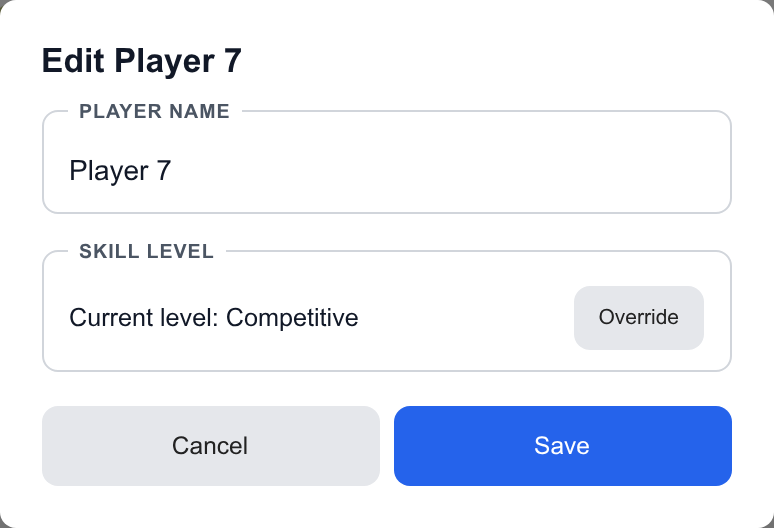
Over time the score follows results, not the label. A player who started as Casual and keeps winning will climb past the Casual number. If you override the level of someone who has already played rated games, the app warns you first, because it resets their Club Score to the new level's starting point.
Why we want you to log scores
Logging a winner (or the full score) takes a moment after each game. Here is what it gives you back:
- Better matching of players. With Skill matching set to Balanced teams, the app uses Club Scores to make both sides the same overall level, so games stay close and nobody gets a lopsided night.
- Competitive play at every level. Because the score reflects who you actually beat, a beginner can have close, meaningful games against other beginners, and a strong player is challenged by strong players. Everyone can compete, whatever their level.
- A view of your progress over time. Your Club Score builds across sessions, so you can see yourself improve week by week, even on nights when you lose to stronger players.
The three Club Score columns on the session leaderboard
With Winner or Full scores on, you can show three versions of Club Score. Turn them on from Advanced → Show on leaderboard.
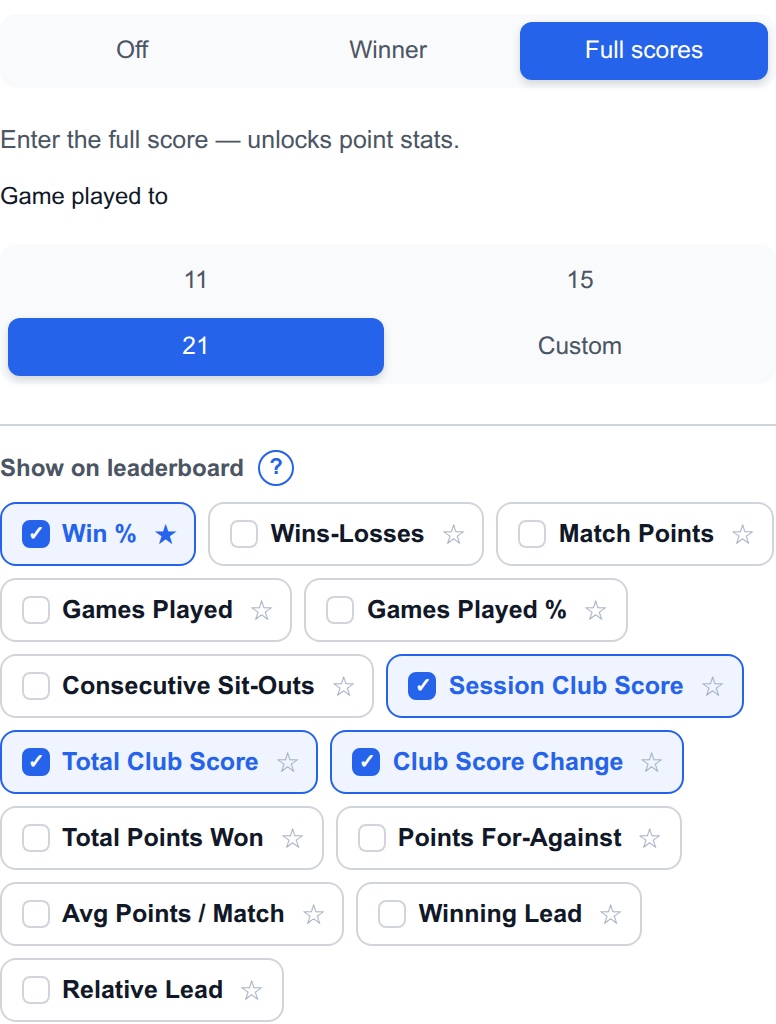
- Total Club Score. The all-time score, carried across every session. The long-run pecking order.
- Session Club Score. A score built from tonight's games only, with everyone starting level at 1000. It answers "who is playing best right now?".
- Club Score Change. How far someone's all-time score moved this session: their Total Club Score now, minus what it was before tonight.
What Club Score can't tell you
- Early numbers are rough. Don't decide anything from five games.
- Doubles blends two people. The app can't see who hit the winners. Over many games with different partners it works it out, but in a handful of games a player can look better or worse than they are because of who they partnered.
- It only knows your group. A 1200 here is strong relative to the people you play, not an official ranking.
Questions about Club Score, or a number that looks wrong? Tell us in the WhatsApp community.
Try Club Score at your next session →
About the numbers
- Screenshots are from a local test build with 16 simulated players over two simulated sessions of 6 and 7 rounds, 3 doubles courts, games to 21.
- The win/lose table uses the same rating library as the app (OpenSkill), for a settled player at 1000 with a partner near 1000, against two equally rated opponents. Real numbers vary with each player's confidence and partner. The +79 and +38 figures use the same setup for a brand-new and a settled player.
- Club Score is OpenSkill's rating multiplied by 40, so the default rating of 25 shows as 1000. The "roughly 25 games" figure is from simulating a default-level player who alternately wins and loses against average opponents. The app stops marking a score with a "?" once its uncertainty value drops below 6. The "settled player" in the table is a player who has played about 40 games (uncertainty about 4.5); the jumps keep shrinking slowly after the "?" disappears.
- Club Scores are recomputed from your logged results in order, so two devices with the same history always show the same numbers.