Two messages reached us in the same week. One player felt they kept meeting the same few people. An organiser asked for the opposite: put players with others of their own level, and only then think about variety.
Both are right, for their own group. A social drop-in wants everyone to mix. A training night wants close, even games. So instead of one fixed recipe, we are building match profiles: the same engine, tuned for the kind of night you run.
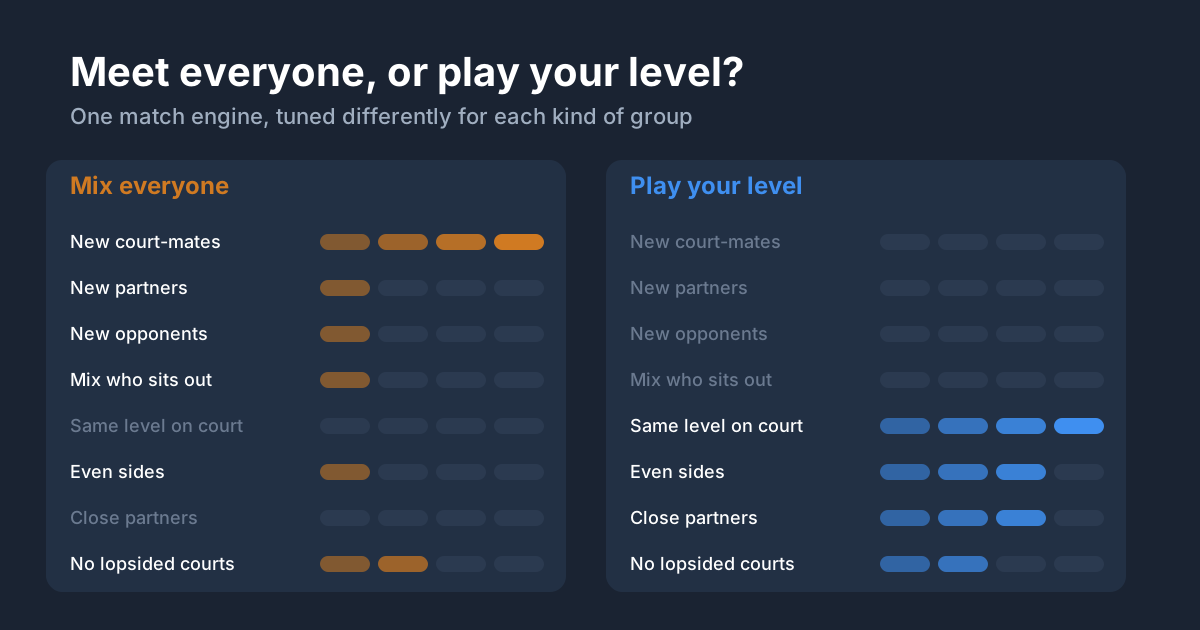
Two goals that pull apart
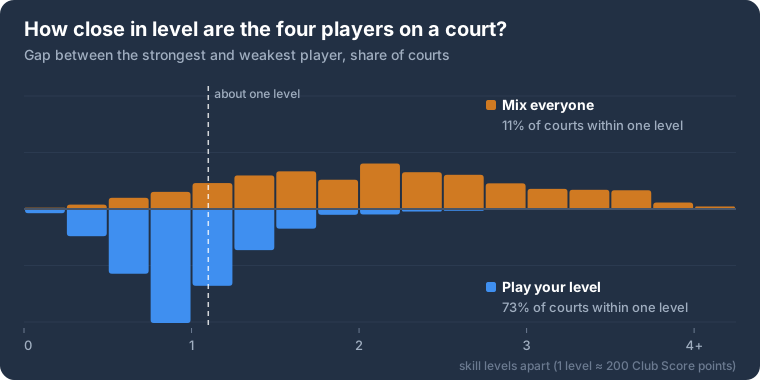
We simulated 300 club nights of 10 games each, about 90 minutes of play, with 12 to 20 players and a realistic spread of abilities. Then we played every night once with each profile.
With Play your level, nearly three in four courts have all four players within one skill level of each other. With Mix everyone, it's about one in ten, because the whole point is to meet people you wouldn't otherwise play.
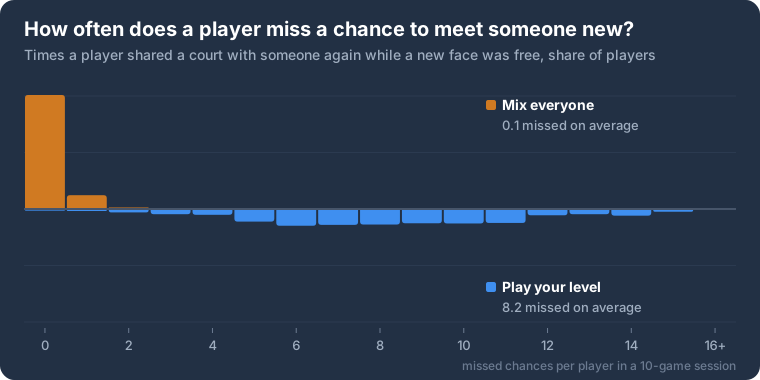
Variety tells the opposite story. We counted how often a player shared a court with someone again while a new face was available. With Mix everyone that almost never happens. With Play your level it happens about eight times a night, because the best match for your level is usually someone you've already played.
Neither is wrong. They are two good answers to two different questions, which is why the choice belongs to the organiser, not to us.
Nudging: one goal first, the rest in small steps
A profile is more than its main goal. We start with the main goal on its own, then nudge each of the other goals up a little at a time. A nudge stays only if the main goal doesn't suffer. When nothing more can be added for free, the profile is done.
The result can be striking. Mix everyone on its own happily puts the club's two strongest players against two beginners. Its tuned version keeps the same variety but almost never makes a lopsided court.
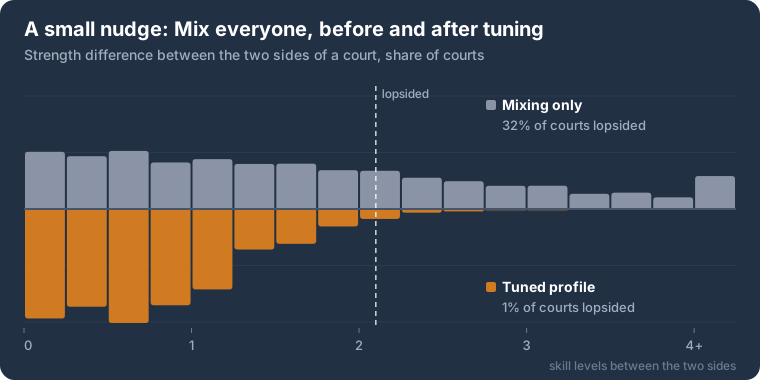
Nudges also show where goals truly conflict. For Play your level, every variety nudge we tried cost some of the level matching. So the profile asks the organiser how much level they'd give up for variety, rather than deciding for them.
What's coming
- Ready-made profiles for common kinds of night: Mix everyone, Balance teams and Play your level. Picking one stays a single tap in session setup.
- An algorithm sandbox for organisers who love the numbers: simulate a night with your own roster, compare two setups side by side, and save the result as your club's own profile.
- Fair sit-outs, always. In every profile, whoever sat out plays the next game and everyone sits out a fair share. Profiles never trade that away.
Which kind of night does your club run? Tell us in the WhatsApp community. Real sessions shape how we tune these profiles.
Start a session with Racket Social →
About the numbers
- 300 simulated sessions per profile: 100 each with 12 players on 2 courts, 17 on 3 and 20 on 4. Abilities are based on a real club roster. Each session is 10 games long.
- "Within one level" means about 200 Club Score points or less between the strongest and weakest player on court. "Lopsided" means the two sides are more than two levels apart.
- These come from a prototype of the profile engine. Numbers will shift a little once profiles are built into the app.